In a custom home build, the relationship between a builder and their trade partners shapes how a project unfolds from the first design meeting to the final installation. For Riemco Design + Build, the partnership with Big George’s Home Appliance Mart has developed over more than two decades into a working relationship between two family-owned businesses that have come to rely on each other.
How the Relationship Began
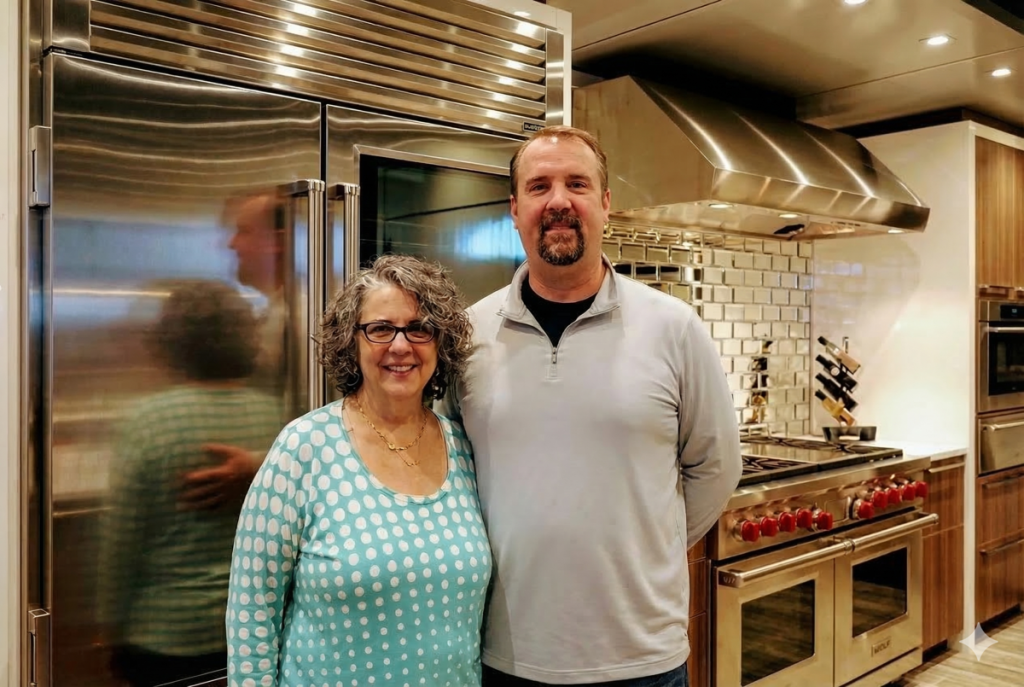
Brad Korican has been part of the Big George’s team since 1998, working his way through nearly every part of the business before settling into his current role in sales. His first connections with Riemco came at the annual home shows, where their booths were near each other each spring. Those conversations turned into a working relationship and, over the years, a genuine friendship.
“I’ve worked with a lot of builders,” Brad says, “and Riemco just has their act together. All their contacts, including heating and cooling and electricians, show up when they need them to show up.”
Cheryl O’Brien, Big George’s Business Development Manager, came to the relationship later through her role managing a rotation of builder accounts across the region. Riemco has been a consistent and valued part of her schedule for more than a decade. “Right when you walk in,” she says, “it’s very friendly, very inviting. Their team has always been cordial and kind and welcoming.”
Brad shares his personal cell number with Rob and Ron, something he reserves for very few builders. Cheryl brings the team treats when she stops by, and when Riemco holds events, Brad and Cheryl are among those they invite.
Appliances and the Build Sequence
Most clients know they will need appliances. What surprises many is how early in the build process those choices need to be made.
Brad describes a typical new build with Riemco: a client comes into the showroom months before installation, often before framing is complete. Appliance selections are finalized, and Big George’s sends those specifications to Riemco. From there, the electrician knows where to run a dedicated circuit. The plumber knows where a water line needs to be roughed in. The ventilation contractor knows what size duct is required. All of that is built into the walls, when drywall goes up, everything is already in position.
“We send them the specs because we want to make sure all the outlets and everything is ready for those appliances,” Brad explains. “And Riemco pays attention. They prep things right.”
On a new build, the working relationship between Big George’s and Riemco can span the full length of a project, from that first showroom visit through the final appliance installation after the cabinets are in and the floors are finished.
When a Project Requires More
Even well-organized projects will encounter complications.
Brad recalls a complete remodel where a homeowner had their heart set on a high-powered professional range. The stove’s electrical requirements were substantial, well beyond what the home’s existing service could support. Installing the appliance as specified would require coordinating with the energy company to upgrade the electrical service from the road to the house, a process that involves permits, scheduling, and considerable persistence.
Riemco coordinated directly with the utility company to assess the situation and bring the service up to what was needed. It was a complex process that required patience and persistence. Riemco worked through it.
“A lot of builders would just say no because they wouldn’t want to take the effort,” Brad says. “Riemco tackled it.”
What’s Changing in the Showroom
Appliance design is in an active period of change. Several trends are shaping what clients are selecting and what builders need to plan for.
Color is back. Deep green finishes, referred to in the industry as alpine green and juniper green, are appearing across appliance categories including refrigerators, stoves, and dishwashers. The color reads as a very dark, near-matte green and is expected to carry significant momentum through 2025 and 2026.
Integration is advancing. Fully integrated appliances, where a refrigerator or dishwasher disappears entirely into the surrounding cabinetry, have moved well beyond the older panel-ready approach where a custom panel covered the front of an appliance but still left a visible seam. In a fully integrated installation, there is no visible seam at all. Touch-to-open and knock-to-open mechanisms allow doors to release without a handle, fitting cleanly into seamless kitchen designs.
The kitchen footprint is expanding. Scullery kitchens, a secondary working kitchen positioned just behind the primary one, are appearing with greater frequency in larger builds. Beverage and coffee centers are making their way into bathrooms and walk-in closets. Two dishwashers are increasingly common for households that keep separate sets of dishes or entertain often.
Energy is reshaping choices. In the Ann Arbor market especially, clients are transitioning away from gas cooking as the city moves toward restricting gas line permits for new construction. Induction cooking has become the preferred electric alternative, particularly in high-efficiency builds where energy input is carefully calculated. In homes designed for maximum efficiency, ventilation through the building envelope is minimized, changing which appliances are eligible.
Mixed metals continue to gain ground, with stainless appliances paired with brass, gold, or black hardware. Matte white is seeing renewed interest, driven by clients building all-white kitchens where the appliances are intended to disappear into the palette.
Two Family Businesses
Both Big George’s and Riemco are family businesses, and both Cheryl and Brad speak about that connection as something genuine.
Brad’s father, Walt Korican , returned home from service in the Vietnam War and stopped by to visit his brother-in-law, who was managing Big George’s at the time. The owner, George himself, was there that day and convinced Walt to come on for the holiday season. Walt stayed, built his career there over the years that followed, and eventually ran the company for more than thirty years. He even met Brad’s mother at the store. Brad and his brother followed him there in time. He grew up with a deep familiarity for what the work involves and what the culture means. His father retired about seven years ago, and the connection he feels to the company is personal in a way that extends beyond his job description.
“It’s one family taking care of another family,” she says. “Riemco is a family business. We’re a family business.”
What Cheryl values most in the partnership comes back to something straightforward. “You take on a big project, like a major kitchen remodel or a custom new build, and you have to be comfortable with those people. You have to be able to communicate with them and get along, because it’s going to be a six-month project.” That comfort, she says, is something Riemco consistently provides. “They answer your questions, make you feel good, and produce at the end of the day.”
The consistency Brad and Cheryl describe, built over more than two decades of shared projects and shared standards, reflects something Riemco carries into every build and renovation. The appliances are one part of that story. The relationship that makes them work is the larger one.